A recording cannot go wrong.
Not the recording itself.
Once it exists, the snare will land in the same place.
The note will crack exactly the same way.
The silence lasts the same number of milliseconds.
You can know every second.
Live music removes that certainty.
The song starts happening now.
Liveness Is Not Just Better Speakers
It is tempting to describe live music as recorded music made louder.
That misses almost everything.
A live performance adds:
the performer being physically present.
visual information.
risk.
audience reaction.
the acoustics of a particular room.
social attention.
movement.
volume you feel in your body.
the knowledge that the moment is happening once.
Even a perfectly reproduced livestream does not preserve all of those conditions.
"Liveness" is a context, not an audio format.
The Performer Can Respond
This is one of the clearest differences.
A recording is fixed.
A live musician can adapt.
Hold a note.
Change tempo.
Wait because the audience is singing.
Extend a section.
Strip something back.
Play harder because the room changes.
Recent research comparing live and recorded music has explored exactly this adaptive quality.
A 2024 PNAS study used a closed-loop setup in which musicians could respond to listeners' neural signals in real time.
The live performances produced stronger and more consistent activity in emotion-related brain networks than the comparable recorded condition.
That is a fascinating finding.
It is not proof that "live music is scientifically better."
It shows that responsiveness changes the event.
We See the Person Making the Sound
Visual information matters.
The body preparing for a note.
Hands on an instrument.
A singer inhaling.
The drummer watching another musician.
Effort.
Strain.
Control.
A smile when something unexpected happens.
Seeing the cause of the sound can change how we interpret it.
A note is not only a frequency.
It is something we watched a person produce.
That can intensify conviction.
Uncertainty Creates Stakes
Even when we know the setlist, we do not know the performance.
Will the singer reach the note?
Will the band change the arrangement?
Will the crowd come in too early?
Will the artist stop talking halfway through a sentence because somebody shouted something ridiculous?
Risk creates attention.
The show has consequence because it cannot simply be replayed from the top.
Mistakes matter.
Recovery matters.
That vulnerability can make a familiar song feel newly alive.
The Best Live Version May Not Be the Cleanest
A technically perfect performance is not automatically the one people remember.
Sometimes the defining live version contains:
a cracked voice.
feedback.
a missed entrance.
a crowd louder than the singer.
a tempo that drifts.
Something somebody would probably correct in a studio.
But the imperfection belongs to the event.
The question is not:
Was this flawless?
It is:
Did something happen in the room?
Our Bodies Respond Differently
Research directly comparing live and recorded performances has found differences in physiological response.
A 2016 study had audience members hear pianists live and later hear recordings of those same performances in the same space.
Physiological measures differed between the conditions.
More recent randomized studies comparing physical live performance with simultaneous livestreams have found higher reported immersion, being moved, arousal or appreciation in live conditions, along with some differences in heart rate or audience synchrony.
Again:
interesting.
Not a universal hierarchy.
These experiments isolate pieces of "liveness."
Actual concerts contain many more variables.
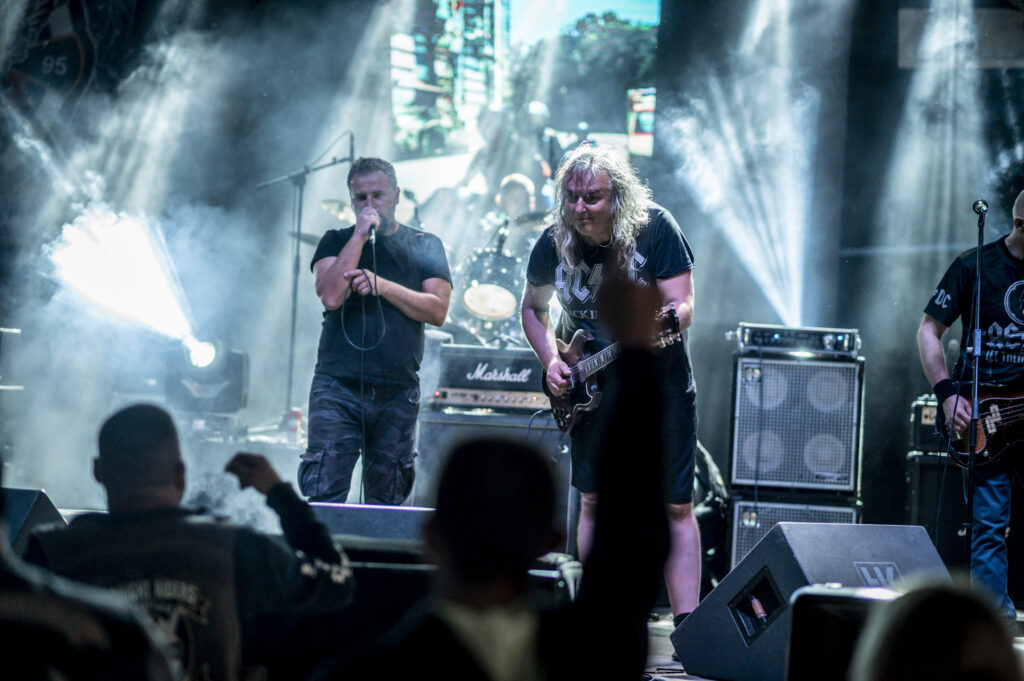
A Crowd Is Part of the Instrument
You do not hear live music alone, even if you came alone.
People cheer.
Move.
Sing.
Go silent.
Laugh.
Talk at the wrong time.
Create anticipation.
The crowd changes the sound field and the emotional field.
A chorus feels larger partly because the room knows it.
An intimate song can become even more intimate when thousands of people stop making noise at once.
The audience is not background.
It is one of the performance conditions.
Collective Effervescence
Social scientists use the phrase collective effervescence for intense feelings of connection and shared significance that can emerge in groups.
Live music is an obvious place to study it.
Research published around 2024–2026 has found relationships between live music attendance, collective effervescence, connection and positive outcomes.
A major 2025 systematic review of social outcomes from live music events found recurring themes around connection, shared experience, community and belonging across a wide range of event types.
This sounds familiar to anybody who has watched strangers become a temporary "we" during a chorus.
But the research helps us be more precise about what we are claiming.
Audience Synchrony Is Real — and Nuanced
Studies of concert audiences have measured forms of physiological and movement synchrony.
Heart rate.
Skin conductance.
Respiration rate.
Movement.
Some measures synchronize more than others.
Some relationships depend on attention, personality or how people are listening.
That is much more interesting than saying:
Everyone's heart beats together at a concert.
They do not literally become one organism.
There are measurable patterns of coordination across audiences.
That is enough.
Common Ground Forms Quickly
A concert also gives strangers a huge amount of shared information.
We know why we are here.
We know which artist matters.
We recognize the opening riff.
We understand why the person beside us suddenly screamed.
We know the words.
That common ground reduces some of the social distance between strangers.
You may never speak to the person next to you.
For two hours, you still inhabit the same emotional architecture.
Live Can Rescue a Song
I love this possibility.
A song does almost nothing for you on record.
Then you see it live.
The arrangement breathes.
The bass is enormous.
The singer changes one line.
The crowd treats the chorus like scripture.
You go home.
Now the studio version carries the room.
The live performance has rewritten your relationship with the recording.
That is not a small side effect.
It is one of the ways songs keep changing after release.
Live Can Also Diminish a Song
The reverse happens.
A track you adore feels strangely lifeless.
The singer sounds disconnected.
The arrangement exposes a weakness.
The audience energy never arrives.
That matters too.
We should not turn "live" into an automatic authenticity badge.
Some music is built for the precision of a studio.
Some performers create conviction through control rather than risk.
Sometimes the record is the better version.
Small Room and Stadium Are Different Forms
A tiny venue can make a performance feel exposed.
You see everything.
Silence matters because there are not enough bodies to hide inside.
A stadium creates another kind of force.
Scale.
Mass singing.
Huge production.
The surreal experience of a private lyric becoming public ritual.
Neither is inherently more authentic.
They create different kinds of liveness.
The question is:
What did this room allow the song to become?
Live Is Therapy — But Not Literally
We use the phrase Live Is Therapy because people speak about concerts that way.
The night they needed.
The release.
The feeling of being alive again.
The crowd.
The catharsis.
That emotional language matters.
It should not be confused with healthcare.
A ticket is not mental-health treatment.
A show does not replace therapy.
The phrase names a lived feeling, not a clinical claim.
That distinction should stay explicit.
Memory Carries the Concert Home
The show ends.
Then something strange happens.
You hear the recording later.
And the live version is still there.
You remember the lights before one lyric.
The person beside you.
The crowd.
The exact place the singer paused.
Now every future listen contains the concert.
A temporary performance has permanently altered a fixed recording.
That may be the simplest explanation for why live music matters so much.
It does not stay live.
It becomes memory.
Why Live Music Feels Different
Presence.
Adaptation.
Risk.
Bodies.
Vision.
Volume.
Synchrony.
Collective attention.
The room.
The knowledge that this version is disappearing while we hear it.
Science can isolate and measure pieces of that experience.
But no single experiment contains the person you came with.
The song you waited years to hear.
The opening act that surprised you.
The line everyone sang.
The walk home.
Those are part of the data of a life, even if they never enter the study.
What song changed after you heard it live — and what happened in the room that the recording could not give you?
Sources / Further Reading
- Trost, W. et al. — "Live music stimulates the affective brain and emotionally entrains listeners in real time"
- Shoda, H., Adachi, M. & Umeda, T. — "How Live Performance Moves the Human Heart"
- Tschacher, W. et al. — "Audience synchronies in live concerts illustrate the embodiment of music experience"
- Tschacher, W. et al. — "Physiological audience synchrony in classical concerts linked with listeners' experiences and attitudes"
- Rickard, N. S. et al. — "The unifying power of live music events: A systematic review of social outcomes for audience members"
- Koefler, N. et al. — "Let the Music Play: Live Music Fosters Collective Effervescence and Leads to Lasting Positive Outcomes"
- Becker, A. S. et al. — "Musician presence and its effects on physiological and psychological well-being in live versus livestreamed concerts"
- Carter, F. et al. — "Live music enhances self-reported audience immersion and physiological synchrony compared to live-streaming"
- Kreuzer, M. et al. — "Western Classical Music Concerts Are More Immersive, Intellectually Stimulating, and Social, When Experienced Live Rather Than in a Digital Stream"
What song changed after you heard it live — and what happened in the room that the recording could not give you?