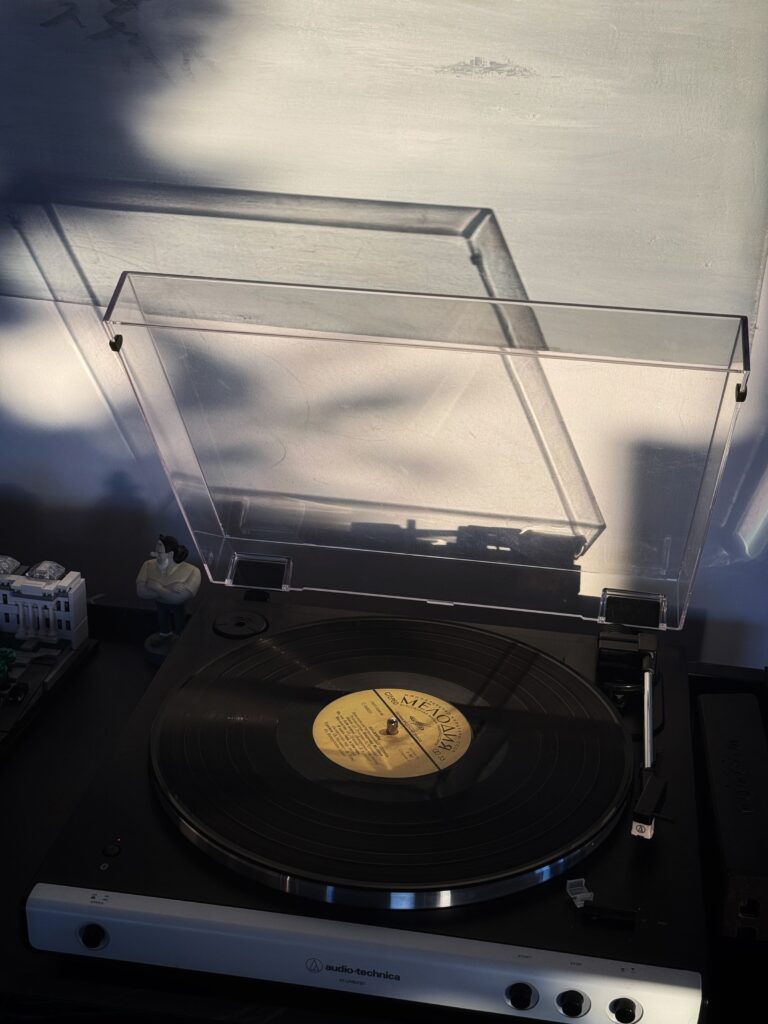
Night changes songs.
Not literally.
The master does not update at midnight.
But when the traffic goes quiet, the phone stops buzzing and there is less world competing for attention, music can feel closer.
Lyrics get through.
Small production choices become enormous.
A song you have heard fifty times suddenly seems to be talking directly to the version of you awake at 1:17 a.m.
That is Late Night Mind.
REFLECT Is Not the Same as RESET
RESET tries to create space when the brain feels crowded.
REFLECT is what happens when the space already exists and you decide to stay inside it.
This is music for thought.
Memory.
Regret.
Wonder.
Questions without immediate answers.
It can be sad.
It does not have to be.
The important thing is that the song leaves room for your own interior life.
1. Radiohead — “How to Disappear Completely”
There is almost no better opening statement for the feeling of being present and absent at once.
The strings refuse simple comfort.
Thom Yorke's vocal feels detached and exposed simultaneously.
The song does not resolve the unease so much as build a beautiful structure around it.
Late Night Mind needs somewhere to begin when thought feels slightly outside the body.
Radiohead — “How to Disappear Completely”
2. Adrianne Lenker — “anything”
Small details can carry entire relationships.
Lenker writes that way.
The song feels almost too close, like overhearing memory being assembled while it is sung.
It does not make the relationship legible in one clean thesis.
That is why it feels real.
Reflection often lives in the ordinary details that survive after the larger story changes.
Adrianne Lenker — “anything”
3. Frank Ocean — “Self Control”
Few songs capture the strange tenderness of looking back at something that has already moved away.
The arrangement becomes more fractured and beautiful as the song continues.
It feels like memory itself changing shape.
Sometimes reflection is not deciding whether something was good or bad. It is accepting that it mattered.
Frank Ocean — “Self Control”
4. Sufjan Stevens — “Should Have Known Better”
Grief changes inside this song.
It does not disappear.
The track moves.
A brighter pulse arrives.
The emotional world expands without pretending the loss is solved.
Reflection can contain movement without becoming a lesson about "moving on.".
Sufjan Stevens — “Should Have Known Better”
5. Phoebe Bridgers — “Moon Song”
This is a song full of emotional imbalance.
Giving more.
Knowing it.
Continuing anyway.
The arrangement barely needs to raise its voice.
The discomfort is in the precision.
Quiet can make an unhealthy truth harder to avoid.
Phoebe Bridgers — “Moon Song”
6. Nick Cave & The Bad Seeds — “Into My Arms”
A piano.
A voice.
A love song that begins by arguing with theology and somehow becomes more intimate because of it.
Cave leaves almost nothing between the listener and the lyric.
Belief, doubt and devotion can occupy the same song without needing to defeat each other.
Nick Cave & The Bad Seeds — “Into My Arms”
7. Bon Iver — “re: Stacks”
This feels like the hour after something.
After the argument.
After the decision.
After the part of the night when the emotion was loud.
There is fatigue in it.
And clarity.
Reflection often arrives after intensity has already spent itself.
Bon Iver — “re: Stacks”
8. Little Simz — “I Love You, I Hate You”
A completely different scale.
Simz confronts a relationship with her father through extraordinary control, anger and detail.
The production gives the thought weight without swallowing the words.
Reflection does not have to be soft. Sometimes thinking clearly requires confrontation.
Little Simz — “I Love You, I Hate You”
9. The National — “About Today”
The song is devastating partly because so little is said.
Distance is the subject.
Space is the arrangement.
The listener is left to fill enormous emotional gaps.
The things we do not say can become louder at night.
The National — “About Today”
10. Gang of Youths — “Do Not Let Your Spirit Wane”
This ends the playlist by widening the lens.
The song contains fear, imagined catastrophe, love, mortality and an insistence toward life.
It is not simple uplift.
It earns the movement.
Reflection should sometimes return us to the world rather than leave us staring at the ceiling forever.
Gang of Youths — “Do Not Let Your Spirit Wane”
Late-Night Listening Makes Detail Bigger
There is less competition.
That is part of it.
At lower external stimulation, a breath before a line can become the event.
The reverb.
A string entering.
A background vocal.
A tiny lyric you had never really heard.
Headphones make that intimacy even stronger.
The music is not in the room.
It is almost inside the head.
Memory Loves This Hour
Late-night music often becomes memory music.
Maybe because we are already reflective.
Maybe because the songs we choose at night tend to be personally meaningful.
Maybe because repeated solitary listening builds strong associations.
Whatever the reason, certain records become permanently attached to bedrooms, night drives and periods of being awake while everybody else seemed to be asleep.
Years later the track can bring the hour back.
Reflection Is Not Always Helpful
A playlist called Late Night Mind could easily become an invitation to spiral.
That is not the goal.
There is a difference between reflection and rumination.
One creates perspective.
The other keeps tightening the same loop.
The distinction is not always obvious while you are inside it.
If this playlist makes the night heavier rather than clearer, stop.
Put on LIFT.
RESET.
Call somebody.
Sleep.
Music does not get points for making suffering aesthetically impressive.
The Songs Do Not Need to Solve Anything
That is the central idea.
There is enormous pressure on emotional music to be useful.
Healing.
Uplifting.
Transformative.
Sometimes a song is useful because it lets a complicated thought remain complicated.
No slogan.
No answer.
No forced resolution.
Just enough shape to stay with it.
When Everything Gets Quieter
Night removes some of the noise around us.
Then music can reveal what was underneath.
A person.
A memory.
A fear.
A question.
An old version of ourselves.
Maybe that is why some songs seem to belong to this hour.
Not because they are sleepy.
Because they are willing to sit beside thought without rushing it.
Sources / Further Reading
- See Article 07 for research on music-evoked autobiographical memory.
- See Article 08 for research on sad music, mood congruence and rumination.
- See Article 06 for the broader science of music and emotion regulation.
What is the song you reach for when everything gets quieter?